
Spinal stenosis is a diagnosis that often comes with a heavy sense of inevitability – as if narrowing in the spine means surgery is just a matter of time. But for the majority of patients with spinal stenosis in Clearwater and across Pinellas County, that isn’t the case. Conservative chiropractic care can meaningfully reduce the pain, improve function, and help patients maintain quality of life without going under the knife – provided the approach is targeted, thorough, and built around what’s actually happening in each individual’s spine.
What Spinal Stenosis Actually Is
Spinal stenosis is a narrowing of the spaces within the spine – either the central canal that houses the spinal cord, the lateral recesses where nerve roots pass, or the foramina through which those nerve roots exit. When these spaces become too narrow, the neural structures inside them get compressed, and symptoms follow.
It most commonly develops gradually as a result of degenerative changes: disc degeneration reduces disc height and allows vertebrae to settle closer together, bone spurs grow inward from the edges of vertebral joints, and spinal ligaments thicken over time. All of these changes slowly reduce the available space for the spinal cord and nerve roots. The condition most frequently affects the lumbar spine (producing leg symptoms) and the cervical spine (producing arm symptoms), though thoracic stenosis also occurs.
Spinal stenosis is most common in adults over 50, though it can develop earlier in people with prior spinal injuries, congenital factors, or accelerated degeneration from heavy physical work.
Classic Symptoms – and Why They’re Easy to Miss
The hallmark symptom of lumbar spinal stenosis is neurogenic claudication – a heaviness, cramping, or weakness in the legs that develops with walking or standing and relieves with sitting or bending forward. Patients often describe feeling fine sitting down but struggling to walk more than a block or two before their legs feel like lead. They instinctively lean forward on a shopping cart, which opens up the spinal canal and temporarily relieves the nerve pressure.
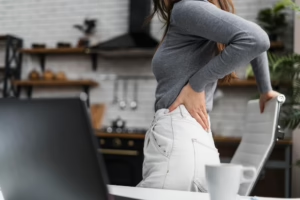
Other symptoms include low back pain and stiffness, sciatica-type symptoms radiating into one or both legs, leg numbness or tingling, and in more advanced cases, bladder or bowel urgency. These symptoms can mimic vascular claudication (poor circulation) or peripheral neuropathy, which is why proper diagnosis matters before treatment begins.
Cervical stenosis produces different symptoms – neck pain, arm weakness, hand clumsiness, and in serious cases a progressive unsteady gait and difficulty with fine motor tasks. Cervical stenosis affecting the spinal cord directly (myelopathy) is a more urgent presentation that requires careful evaluation before conservative care proceeds.
What Chiropractic Care Can Do for Spinal Stenosis
Let’s be direct about the limits first: chiropractic care cannot reverse structural stenosis. The bony narrowing visible on imaging is a structural reality that conservative treatment doesn’t change. What chiropractic care can do – very effectively – is reduce the functional consequences of that narrowing, improve spinal mobility around the stenotic segments, decrease nerve irritation, and help patients maintain meaningful activity levels that pain and stiffness would otherwise prevent.
Many patients with significant stenosis on imaging live with minimal symptoms when their spinal mechanics are well-managed. Conversely, patients with relatively moderate structural stenosis can have severe symptoms if the surrounding joints are restricted, the muscles are in chronic spasm, and the spine is loaded poorly. The functional factors are often what’s most treatable – and most responsible for day-to-day quality of life.
At LiveWell Chiropractic Health Center in Clearwater, we assess both the structural picture and the functional picture before building a treatment plan. Spinal X-rays taken on-site give us current alignment and disc spacing data. If you have recent MRI findings, we review those as well to understand the degree and location of the stenosis before any treatment begins.
Gentle Chiropractic Mobilization
Traditional high-velocity adjustments are modified or replaced with gentle mobilization techniques for stenosis patients, particularly in the lumbar spine. The goal is to restore as much joint motion as possible in the segments above and below the stenotic area without compressing the already narrowed spaces. Improved mobility in adjacent segments takes compensatory load off the affected levels and reduces the pain and stiffness that comes from the surrounding joints bearing too much of the mechanical burden.
Spinal Decompression Therapy
Spinal decompression is particularly well-suited to stenosis because it directly addresses the compression of the nerve structures. The distraction force creates more space within the spinal canal and foramen temporarily, reducing the mechanical load on irritated nerves. Over a series of sessions, many patients notice significant reductions in leg symptoms, improved walking tolerance, and decreased pain. It’s one of the most consistently effective conservative treatments available for symptomatic spinal stenosis.
Rehabilitation and Postural Work
Core strengthening, hip flexor release, and posture correction all play a role in managing stenosis long-term. A stronger, better-supported spine loads the narrowed segments less aggressively during daily movement. Our rehabilitation program is tailored specifically to what each patient’s spine needs – not a generic exercise protocol applied uniformly.
Lifestyle Guidance
How you move through daily life matters enormously with spinal stenosis. Specific guidance on activity modification, posture during prolonged standing or walking, and strategies for managing symptom flares gives patients practical tools they can use every day – not just during treatment sessions.
When Surgery Becomes Necessary
We’re honest about this because patients deserve a realistic picture. Surgical intervention for spinal stenosis becomes appropriate when there is progressive and significant neurological deterioration – worsening weakness, loss of bladder or bowel function, or spinal cord compression producing myelopathic changes. These situations require prompt orthopedic or neurosurgical evaluation and conservative care is not the right first step.
For the much larger group of stenosis patients dealing with pain, leg heaviness, and activity limitation without those severe neurological features, conservative chiropractic management is appropriate, effective, and worth pursuing thoroughly before considering surgery. Our location within the Ortho Integrative Medicine Institute in Clearwater also allows for coordinated care with orthopedic specialists when a collaborative approach serves the patient best.
Frequently Asked Questions
Is chiropractic safe with a stenosis diagnosis?
Yes, when the approach is adapted appropriately. We review imaging, assess neurological status, and modify techniques to ensure we’re working within safe parameters for each patient’s specific degree of stenosis. High-force techniques are generally avoided, but gentle mobilization and decompression are very well-tolerated by most stenosis patients.
How many sessions does spinal stenosis typically require?
Stenosis is a chronic condition, so management is ongoing rather than curative. An initial active treatment phase typically runs 6-12 weeks depending on symptom severity. Many patients then transition to periodic maintenance care to keep the functional gains they’ve made. We’re transparent about what that looks like at your initial consultation.
Can stenosis get worse with chiropractic care?
When care is based on a thorough assessment and appropriately modified techniques, this is uncommon. If anything, leaving stenosis-related joint restriction and nerve irritation unaddressed tends to allow functional decline to progress faster than properly managed conservative care. We monitor closely and adjust if anything doesn’t respond as expected.
If you’ve been diagnosed with spinal stenosis in the Clearwater area and want to understand your conservative care options before making decisions about surgery, we’d be glad to do a thorough evaluation. Call us at (727) 591-0550 or book your consultation online at LiveWell Chiropractic Health Center.