
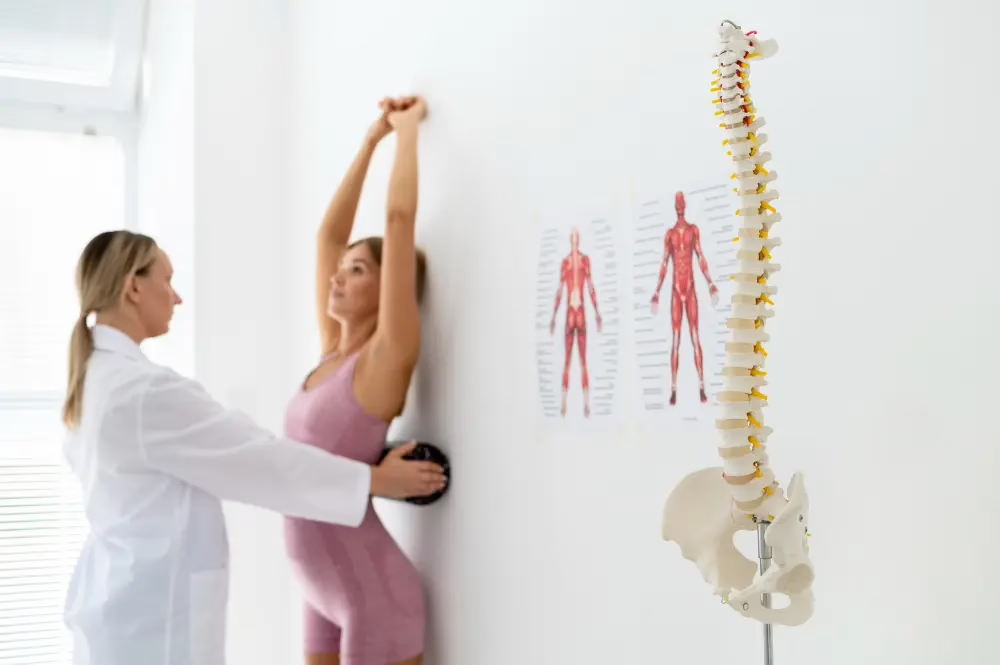
Scoliosis doesn’t have to mean a lifetime of pain, limitation, or inevitably worsening curvature. While chiropractic care can’t straighten a scoliotic spine the way surgery can, it plays a meaningful role in managing symptoms, improving spinal function, slowing progression in some cases, and helping patients maintain quality of life at every age. For families and adults in Clearwater dealing with a scoliosis diagnosis, understanding your non-surgical options is an important first step.
What Is Scoliosis, Really?
Scoliosis is an abnormal lateral curvature of the spine – meaning the spine curves to the side rather than running straight up and down. In some cases it also involves rotation of the vertebrae, which creates the characteristic rib prominence or uneven shoulder and hip appearance many people associate with the condition.
Curves are measured in degrees using the Cobb angle method on X-ray. A curve under 10 degrees is considered a normal variant. Curves between 10-25 degrees are mild, 25-40 degrees are moderate, and anything over 40-45 degrees is typically where surgical discussion begins. The vast majority of scoliosis cases fall in the mild to moderate range – and those cases have the most to gain from conservative chiropractic management.
The most common type is idiopathic scoliosis, which develops without a clearly identified cause. It most often appears during adolescent growth spurts. But scoliosis also develops in adults as a result of degenerative disc changes, osteoporosis, or as a progression of a curve that was present in childhood but not treated.
What Chiropractic Care Can and Can’t Do for Scoliosis
Let’s be straightforward about this. Chiropractic care is not a cure for structural scoliosis, and it won’t permanently straighten a spinal curve. Anyone claiming otherwise is overpromising.
What chiropractic care can do is reduce the pain and discomfort associated with scoliosis, improve spinal mobility and function, address the muscular imbalances that develop around an abnormal curve, support better posture and spinal mechanics, and in some cases help slow curve progression – particularly in adolescents whose spines are still developing.
For many patients, that’s genuinely life-changing. Scoliosis-related pain, stiffness, and the fatigue of compensating around an uneven spine are real quality-of-life issues. Addressing those effectively – without surgery – is meaningful care.
Dr. Fisher’s Specialized Training in Scoliosis Management
Not every chiropractor has specific training in scoliosis. Dr. Travis Fisher, DC holds advanced certification from The Clear Institute, which specializes in scoliosis detection, assessment, and non-surgical spinal rehabilitation. He also holds Pettibon system certification, which focuses specifically on postural correction and spinal biomechanics – both directly relevant to managing scoliotic curves.
That specialized background means scoliosis patients at LiveWell Chiropractic Health Center receive care that’s informed by specific training in their condition, not a general chiropractic approach applied to a complex spinal problem.
How We Assess and Treat Scoliosis
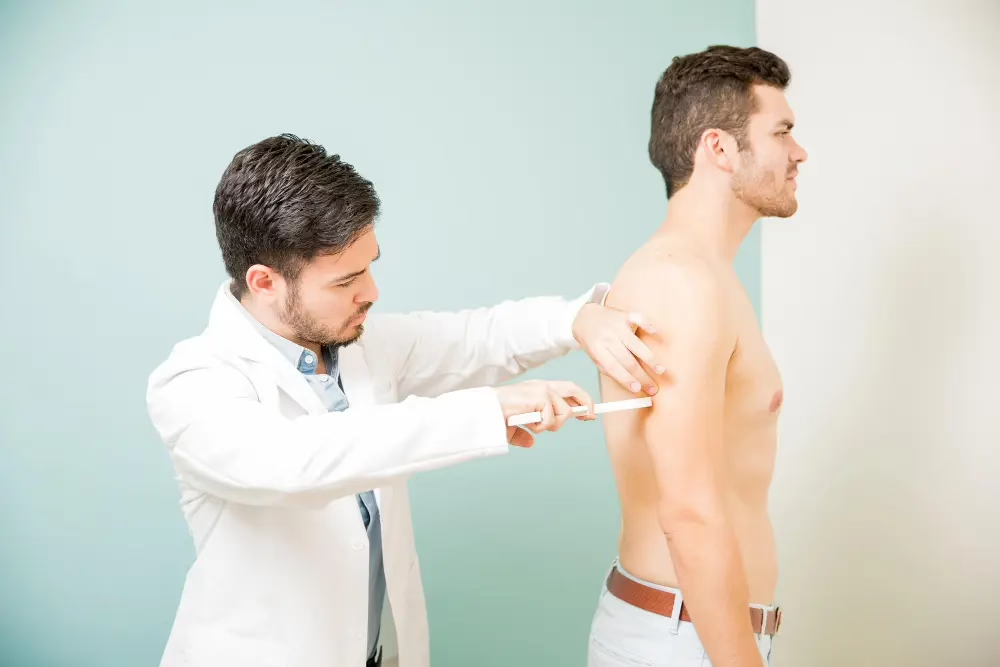
Every scoliosis patient starts with a thorough assessment. We review any prior imaging you have, and if current X-rays are needed, we can take those on-site. Understanding the degree and location of the curve, the direction of rotation, and where the compensatory patterns are is essential before treatment begins.
We also assess overall posture, muscle balance, spinal range of motion, and neurological function. Scoliosis almost always creates predictable muscle imbalances – the muscles on the concave side of the curve become shortened and tight, while those on the convex side become lengthened and weakened. Addressing those imbalances is a central part of the treatment plan.
Chiropractic Adjustments
Specific, targeted adjustments to the most restricted segments of the spine improve joint mobility and reduce the compensatory strain that builds around an abnormal curve. The goal isn’t to force the spine straight – it’s to optimize the function of the joints that are there and reduce the mechanical stress on the surrounding tissues.
Postural Correction and Mirror-Image Rehabilitation
Mirror-image exercises and posture training work in the opposite direction of the curve to reduce its functional contribution. Over time, consistent corrective exercise can influence the soft tissue component of the curve and help maintain improvements achieved through adjustments.
Soft Tissue Therapy
Releasing the chronically tight muscles on the concave side of the curve and activating the weakened muscles on the convex side changes the forces acting on the spine. This muscle balancing work is something many scoliosis patients have never had specifically addressed, and it often produces noticeable relief.
Spinal Rehabilitation
Our chiropractic rehabilitation program incorporates the full picture – adjustments, corrective exercises, posture training, and home care guidance that patients can maintain between visits. Scoliosis management is an ongoing process, and giving patients the tools to actively participate in their own care is part of how we approach it.
Scoliosis in Children and Adolescents
Adolescent idiopathic scoliosis is the most common form and typically progresses most rapidly during growth spurts. Early detection and conservative management during this window is important because the spine is still developing and more responsive to corrective influence.
If your child has been diagnosed with scoliosis or you’ve noticed uneven shoulders, a prominent shoulder blade, or one hip sitting higher than the other, a chiropractic evaluation is a practical next step. Our pediatric chiropractic care is adapted for younger patients, using gentle techniques appropriate for developing spines.
We work alongside medical providers – including orthopedists who may be monitoring the curve with periodic imaging – rather than instead of them. If a curve is progressing toward a range where bracing or surgical consultation is warranted, we’ll tell you clearly.
Scoliosis in Adults
Adult scoliosis – whether a childhood curve that was never fully addressed or a degenerative curve that developed later in life – presents somewhat differently than adolescent scoliosis. Pain is typically the primary concern rather than curve progression, though progression can still occur.
Adults with scoliosis often deal with chronic back pain, uneven loading through the hips and knees, and fatigue from years of compensating around an abnormal spinal pattern. Chiropractic care tailored to the adult scoliotic spine can significantly improve comfort and function even when the structural curve itself can’t be substantially changed.
Frequently Asked Questions
At what age can chiropractic care help scoliosis most?
Earlier is generally better for curve management, particularly in adolescents whose spines are still growing. That said, chiropractic care for symptom management and functional improvement is beneficial at any age. Adults with long-standing scoliosis regularly see meaningful improvements in pain and mobility.
Will I need to come forever?
Scoliosis is a structural condition, so ongoing maintenance care often makes sense for managing it long-term. That said, we’re transparent about what active treatment looks like versus a maintenance schedule. We never recommend more visits than we believe genuinely serve your wellbeing.
Can exercise make scoliosis worse?
General exercise is not harmful for scoliosis and is usually encouraged. Certain asymmetric sports or repetitive one-sided activities may need modification depending on the curve’s location and severity. We’ll discuss any activity-specific considerations during your consultation.
If you or someone in your family in the Clearwater area is managing scoliosis and wants to explore what conservative chiropractic care can offer, we’d be glad to do a thorough evaluation. Call us at (727) 591-0550 or book your consultation online at LiveWell Chiropractic Health Center.