

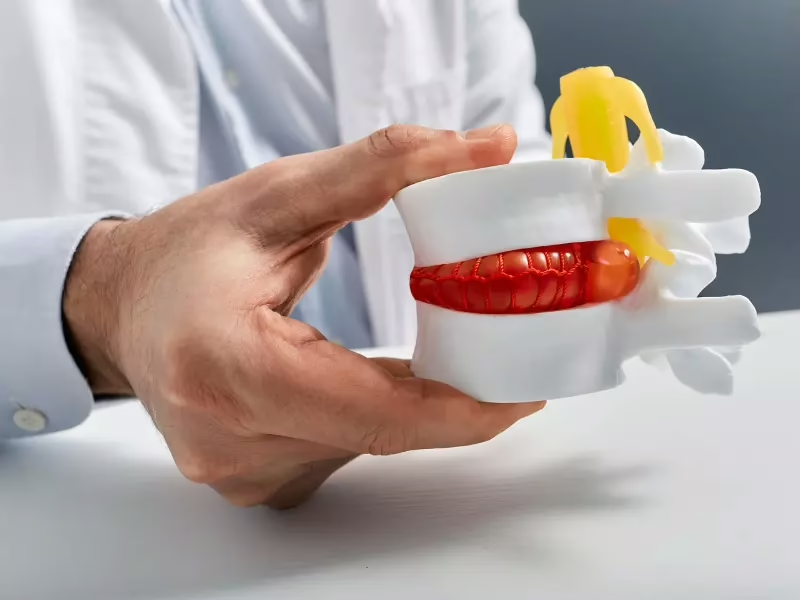
Herniated disc and bulging disc get used almost interchangeably, but they’re not the same thing. Both involve a spinal disc that’s no longer in its normal shape, and both can cause pain, but the difference matters for understanding what’s happening in your spine and how it’s best treated. If you’ve been given one of these diagnoses and weren’t sure exactly what it meant, here’s a clear explanation of both and how chiropractic care approaches each.
A Quick Look at What a Disc Is
To understand the difference, it helps to picture the disc itself. Between each pair of vertebrae in your spine sits a disc that acts as a cushion and shock absorber. Each disc has a tough, fibrous outer ring and a soft, gel-like center. Think of it a bit like a jelly doughnut, with a firm outer layer surrounding a softer middle.
When that structure changes shape or gets damaged, it can press on nearby nerves or the spinal canal, which is where the pain and symptoms come from. Both bulging and herniated discs involve this kind of change, but to different degrees.
What a Bulging Disc Is
A bulging disc happens when the disc flattens and extends outward beyond its normal boundary, a bit like a tire that’s underinflated and bulges out at the bottom. The outer layer is still intact, but the whole disc has spread out past where it should sit.
Bulging discs are extremely common and often develop gradually with age as the discs lose some of their height and resilience. Many people have bulging discs and don’t feel a thing, because a bulge only causes symptoms if it presses on a nerve or narrows the space the nerves travel through. When a bulging disc does cause problems, it’s usually because it’s encroaching on a nerve, producing pain, stiffness, or in some cases symptoms that radiate outward.
What a Herniated Disc Is
A herniated disc is a step further. Here, the tough outer layer has actually cracked or torn, allowing some of the soft inner material to push out through the opening. Going back to the jelly doughnut, this is when the jelly starts squeezing out through a break in the outer layer.
Because the inner material is now protruding, a herniated disc is more likely to press directly on a nerve root, and it can also produce chemical irritation of the nerve from the disc material itself. This is why herniated discs often cause more pronounced symptoms, including sharp pain, numbness, tingling, or weakness that travels along the path of the affected nerve. A herniated disc in the lower back can produce sciatica, while one in the neck can send symptoms down the arm.
The Key Difference in Simple Terms
The simplest way to think about it is this. A bulging disc is a disc that’s spread out beyond its normal boundary with its outer layer still intact. A herniated disc is a disc whose outer layer has torn, letting the inner material escape.
A bulge is a change in shape. A herniation is a breach. A herniated disc is generally the more significant of the two, though this isn’t an absolute rule. A large bulging disc pressing firmly on a nerve can cause more symptoms than a small herniation that isn’t touching anything important. What ultimately matters is not just the label but whether and how the disc is affecting the surrounding nerves.
Why the Distinction Matters
Understanding which one you have helps make sense of your symptoms and what to expect. It also matters because the two can represent different stages. A bulging disc that’s under continued stress can eventually progress to a herniation if the outer layer gives way. Addressing a bulging disc and the mechanics stressing it can help prevent that progression.
That said, the treatment approach for both shares a lot of common ground, because in both cases the goals are to reduce pressure on the affected nerve, take stress off the damaged disc, and improve the mechanics that contributed to the problem.
How Chiropractic Care Addresses Both
At LiveWell Chiropractic Health Center in Clearwater, treatment for both bulging and herniated discs starts with a thorough assessment to understand which disc is involved, how it’s affecting the nerves, and what mechanical factors are contributing. If you have existing imaging, we review it, and when appropriate, on-site X-rays help clarify the structural picture.
For both conditions, spinal decompression therapy is often central to care. The gentle traction creates negative pressure within the disc, which helps draw the bulging or herniated material inward, away from the nerve, and improves the flow of nutrients that support disc healing. It addresses the disc problem directly and non-surgically.
Chiropractic adjustments restore proper movement and alignment to the spine, reducing the mechanical stress on the affected disc and the surrounding structures. And rehabilitation exercises rebuild the core and spinal support needed to take pressure off the disc and reduce the risk of the problem returning or progressing. The plan is tailored to whether you have a bulge or a herniation and how it’s behaving.
When to Seek Care
If you’ve been diagnosed with either a bulging or herniated disc, or you have back or neck pain with symptoms radiating into an arm or leg, it’s worth having a proper assessment. Both conditions respond well to conservative care in the majority of cases, particularly when addressed before they worsen.
Certain symptoms warrant urgent medical attention rather than routine care, including significant or progressive weakness, or any loss of bladder or bowel control. We’re always honest about when something needs a different level of care.
Frequently Asked Questions
Is a bulging disc less serious than a herniated disc?
Generally a bulging disc is a milder change than a herniation, since the outer layer is still intact. But severity depends on whether the disc is pressing on a nerve, not just the label. A large bulge on a nerve can cause more trouble than a small herniation that isn’t.
Can a bulging disc turn into a herniated disc?
Yes, it can. A bulging disc under continued stress can eventually progress to a herniation if the outer layer tears. This is one reason addressing a bulging disc and the mechanics stressing it is worthwhile rather than simply waiting.
Can chiropractic care fix a herniated or bulging disc?
Chiropractic care, especially with spinal decompression, can reduce the pressure on nerves, take stress off the disc, and support healing, which resolves symptoms for many patients without surgery. It doesn’t regrow the disc, but it addresses the mechanical problem and often provides lasting relief.
If you’re dealing with a disc issue in the Clearwater area and want to understand your options, we’d be glad to help. Call us at (727) 591-0550 or book your consultation online at LiveWell Chiropractic Health Center.